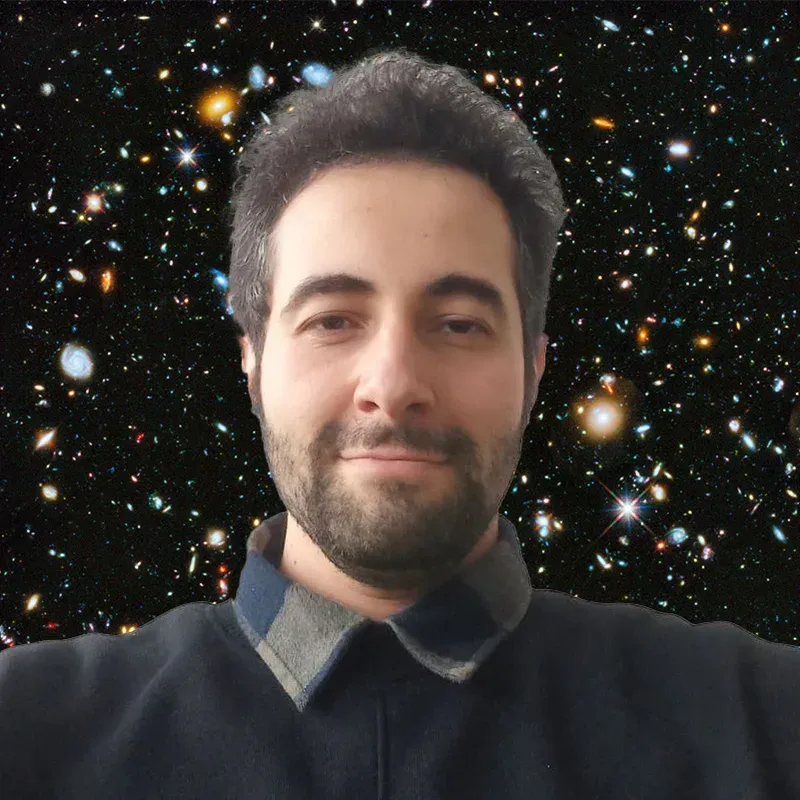
Ernst Patzer Prize
MPIA Heidelberg, 2023
For introducing the closure radius and its universal scaling relation.
I am an astrophysicist and computational scientist, currently the Independent Argelander Fellow at the University of Bonn, where I study how galaxies form and evolve — and how the physical processes behind that evolution shape the large-scale structure of the Universe.
In practice, I build theoretical models of galaxy formation, implement them in cosmological simulations and semi-analytical models, and test their predictions against observational data. A recurring theme of my work is how physical processes reshape the distribution and dynamics of baryonic matter relative to the dark matter, which evolves under gravity alone. In more technical terms, I develop interpretable, scalable, and predictive models for high-dimensional physical systems — combining analytical theory and numerical simulations with high-performance computing (HPC), machine learning, simulation-based inference, and GPU-accelerated scientific computing.
I received the 2023 Ernst Patzer Prize for introducing the Closure Radius, a characteristic scale that quantifies where ordinary matter displaced from its host dark matter halo becomes enclosed again. I am also a main developer and PI of several numerical simulation projects that connect theoretical models, computational methods, and cosmological big data.
I live in Bonn with my wife, and speak Persian, English, and German.
University of Tehran · Tehran, Iran
Sharif University of Technology · Tehran, Iran
Max Planck Institute for Astrophysics & LMU Munich · Garching and Munich, Germany
Max Planck Institute for Astrophysics · Garching, Germany
Centre for Astronomy (ZAH), Heidelberg University · Heidelberg, Germany
Argelander Institute for Astronomy, University of Bonn · Bonn, Germany
MPIA Heidelberg, 2023
For introducing the closure radius and its universal scaling relation.
University of Bonn, 2024 – 2027
Accepted in preference to a competitively awarded independent postdoctoral fellowship in the U.S.
Leibniz Supercomputing Centre (LRZ), 2026 – 2027
A competitively awarded, peer-reviewed allocation for the iCluster simulations, on my application as PI.
How I work
I describe my work as the intersection of theory, computation, and observation — with the goal of understanding the fundamental processes that govern the Universe.
Developing theoretical models of how galaxies and cosmic structures form and evolve.
Implementing them in cosmological simulations and semi-analytical models on HPC systems.
Testing the results against observational data, and letting what we see guide the next model.
Questions about my research, the simulations or the data, or interested in a student project? I am happy to hear from you.